
News Letter January 2017
Bo Newsletter January 2017
We have just got back from a self-funded visit to St Paul’s School to celebrate the 10th anniversary of the school and our involvement with it, giving some of the world’s poorest children a chance in life. It was an exciting and encouraging visit and we want to invite you to attend one of our free events where you can find out more about the project and the sponsored children, see the videos, talk to those who visited, and get a feel for the wonderfully positive atmosphere out there as the community puts the Ebola crisis behind it and plans for the future, a future in which we are an accepted part.
First off is a Songs of Praise service in West Wittering Church, 4pm on Sunday 29th January where we will celebrate the school’s 10 years and the visit, tell you about it and show you the pictures, and the collection will go to the school. The second is a reception with refreshments in the WW Memorial Hall’s Jubilee Room, 7-9pm on 25th February, again this is free but any donations will go to the school.
There is still much poverty and hardship out there, but also much hope for the future, and many many ways in which we can help them build that future and give their children the hope that for them and their families things will be brighter and better. 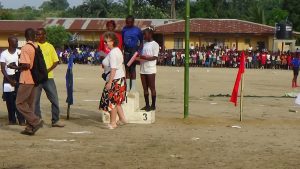
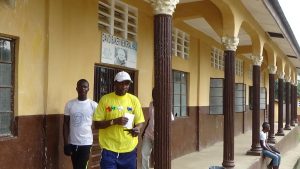 sports day head Solomon at the Memorial Hall
The visit was timed to coincide with the school sports and speech days and a thanksgiving service for the school which was held in the Cathedral church on the Sunday, following a four-hour ordination service in the morning, at which six new priests and one deacon were ordained, almost doubling the number of active Anglican priests in the Diocese of Bo. We were tirelessly hosted throughout by the Education Secretary, Edward Luseni; so were able to discuss and sieve through many issues as they arose. We also met head teacher Solomon Scot-Manga several times; the teachers including the now eleven unpaid teachers; and the scholarship committee who vet candidates for sponsorship. This latter committee work closely with the pupils families or guardians and impressed us greatly. We hope to involve them in sponsorships for further education and work place training schemes, one of which is being run by Edward Luseni for street traders, and others by the Mother’s Union. We spent a lot of time in the school which now has 728 pupils and at the sports days which were festive family events; colourful, competitive and celebratory. The speech day was more formal but still lively with the school brass band playing and a lot of singing. The standards the school has achieved are high and all are rightly proud of their achievements and of the school itself which now boasts an ‘Old Boys/girls Association’ which has its own smart navy blue uniform. While we were there the BECE (GCSE equivalent) results were published and St Paul’s achieved an exceptional 95% pass rate.
Everywhere we went we were welcomed warmly and effusive thanks were sent back with us to all the supporters and especially the folk of West Wittering, now the undisputed centre of the UK. Everyone has plans for the future and as we explored different avenues through which we might help the school and children, we encountered many other ideas which would be good for both school and community and especially the marginalized in society; orphans, Ebola victims, single parent and no-parent families, often also Ebola victims. Despite the poverty everyone was working to improve things rather than just accept the status quo. There was no hint of self-pity, just a determination to put the past behind them and, because we have a track record as a community which has stood by them through thick and thin, to include us in their plans wherever possible.
The Mother’s Union were at the centre of most schemes to help those in real need, providing care for Ebola Orphans, a pre-school nursery which allows single mums to get out and work, and on the job training for those seeking tailoring or hairdressing skills. Diocese-wide agricultural schemes were also part of their agenda. They have no money for any of the above and really work hand to mouth, teachers and helpers are paid only when money is available. They were presented with a banner commemorating their life-saving work during the Ebola crisis during the ordination service. The banner made by Judy Francis and given by Gerry Holben was dedicated by Bishop Jacques, Bishop of Guinea. To say the MU were delighted with it is an understatement. Every branch wanted it so they are going to make copies for each one.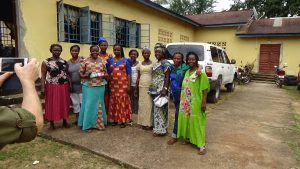
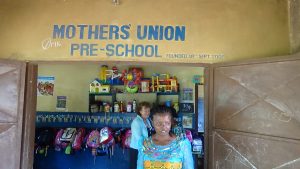
leaders of the Diocese-wide MU pre-school for 70 from single-parent families
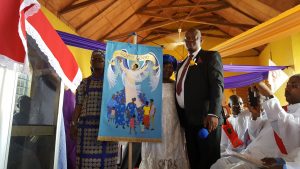
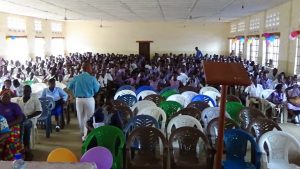
presentation of the MU Banner speech day in the David Baker Hall
We want to tell you more and show you the videos and pictures so we hope to see you at one of the two events already mentioned. Details of them and the visit will appear shortly on our WEBSITE – www.slbsa.co.uk – stands for ‘sierra leone bo school appeal’ which is easier to remember. Usually our newsletters contain forms for sponsoring children but there is no room this time and anyway all the details and forms for this are also on the WEBSITE, so if you would like to give a disadvantaged child an education and a chance in life they wouldn’t otherwise have and can afford £5/month, please go to the website. Go to the website anyway as over time we will get all the details of the visit plus updates on events and sponsored children so you should find it interesting and up to date and at the same time get a real sense of achievement from the difference you are making in a poor community which once was without any support and had no hope of a better future.